Why Isn’t My Refund as Big as my Friends?
I get this question every year. Why did my friend, neighbor, co-worker, relative, etc. get a bigger refund than I did? And the honest answer to that question is: I don’t know, I didn’t prepare their taxes. But here are some common reasons why some people might get a bigger refund than you do.
1. They withheld more. That’s the simplest explanation. Technically, you only get back if you overpaid your taxes. So, people who withhold too much, get refunds. If you get less, that actually means you win because you didn’t over withhold. (But trust me, I know. It really doesn’t feel like winning.)
2. They qualified for the earned income tax credit. EItC is one of those tax credits that you can actually receive even if you didn’t pay anything into the system. But—there are many requirements—most notably you have to have earned income. The EIC can make a huge difference in someone’s refund.
3. College tax credits—the American Opportunity Credit can be worth up to $2,500 on someone’s tax return. If your friend was attending school while you stayed home—that could be part of the difference also.
4. Different filing statuses—if you’re single, you could be in a higher tax bracket than your married friend. Or, if you’re married and your wife is also working—then you could be in a higher tax bracket than your single friend. Even though two people have the same job and earn the same amount of money—their circumstances outside of work could have a huge impact on their tax refund.
5. Different deductions—once again, it all has to do with things that happen outside of work. A person renting an apartment could be paying higher taxes than someone paying a mortgage because of the mortgage interest deduction—or any number of other deductions. There are just too many things to name.
6. Income—The more money you make, the more tax you pay. And people who make a lot of money have to pay the alternative minimum tax or AMT.
So, don’t waste your time worrying about your friend’s refund. The important thing is to think about what your goals are. Do you want a big refund? If so, how big of a refund do you want and what would you do with it?
Or would you rather take home more money with each paycheck? If so, what will you do with the extra take home pay?
But whether you choose a larger refund, choose larger take home pay, or maybe choose some middle ground; our job at Roberg Tax Solutions is to help you pay the least amount of tax while making smart decisions for yourself and your family. As long as you’re doing what’s best for you, it really doesn’t matter what your friends are doing anyway now does it?
How to Split Your Refund
Are you getting a refund this year? What are you going to do with it? My refund will be paying for some repairs to my house. (I got hit really badly by one of those storms in 2012. Ouch!)
Were you thinking about saving? Or maybe funding your IRA? Or are you like me and you’re spending it on something special? (Okay, I’d rather be saving up to go to Hawaii or something but I’ve got a special savings account set up to pay for my house repairs.)
Here’s my problem—if I get a large refund and it goes straight to my checking account, I will spend it or least a good portion of it, before it makes its way to my savings account. But if the money is in my savings account—it doesn’t come out unless it absolutely has to. (I’m lousy at putting the money in, but once it’s in there, I’m a gatekeeper!) The best thing to keep me and my husband from fighting is to pick where the money should go before we have it in our hands. We can do that with the IRS 8888 form. http://www.irs.gov/pub/irs-pdf/f8888.pdf
The Form 8888 lets you split your refund. You can use the regular 1040 form to have your refund direct deposited to your bank account, but with the 8888 form, you can have part of your refund go to your checking and part of it go to your savings. You can make deposits in up to three different accounts!
This gives you options. You could fund your IRA, your spouse’s IRA and then put some money in your savings too. If you’re really good.
You can even use the split refund to buy US Savings bonds for you, your kids, or your grandchildren. Here’s some more information about that: http://robergtaxsolutions.com/2011/01/tax-time-savings-bonds/
You could (although I confess I’ve never had anyone do this in my office) have your refund split between three bank accounts, buy two savings bonds, and have the IRS issue you a check for whatever’s left over. The point is, you’ve got options.
Here’s some FAQ’s about splitting your refund:
What happens to my split refund if I figured my tax wrong?
If you are getting more money—the amount goes into the first account listed on form 8888.
If you are to get less money, the IRS takes it out of the last account listed in part 1.
Can I use form 8888 if I file an injured spouse return?
No.
What happens if I have an offset for student loans or child support?
Personally, I would skip the 8888 if that‘s a possibility for you. But there’s a whole routing order for how those are handled and it’s in the instructions on the form.
Fraud alert: Do not use the form 8888 to put money into your tax preparer’s bank account. It’s against the law. If you need to pay for your tax preparation with your refund it should be routed through a bank that does that. If you’re not splitting your refund and your preparer hands you a Form 8888—take your paperwork and go someplace else.
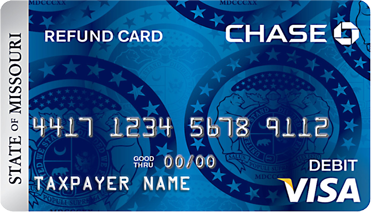
State of Missouri Refund Debit Card
This year, the state of Missouri is offering you the option of getting your refund from your 2012 Missouri tax return on a refund debit card. You can qualify if you’re getting a refund on your individual MO-1040 or on a Property Tax Credit Claim.
To get the debit card, all you have to do is mark the “debit” card box on the refund line of your 2012 Missouri income tax return. How easy is that?
You don’t pay any extra charge to get the card. You don’t have to have a bank account. And once you activate your card you’ll have 24 hour access to your cash.
You’ll receive your refund card in the mail and you’ll have to activate it by phone or online. You’ll need to create a personal identification number to use it.
You’ll be able to use the card anywhere a VISA is accepted.
Here’s a video about the debit card and how it works: Missouri Debit Card Video
It’s important to know that having your refund direct deposited into your checking or savings account is still the fastest way to get your refund. But if that’s not an option for you, then this refund card is a really cool alternative.
Turbo Tax Users: You Need to do a Three Year Review
Filed under: Divorce, Do It Yourself, Refunds, Review
I’ve said it before: I think Turbo Tax is a great product. I also like 1040.com, the do it yourself software you can get on my website. Good products, good results. But, they’re not perfect—none of them are. And neither are tax preparers, after all they are human and make mistakes as well.
It’s August, generally quiet time in the tax business—but no, not this week. The other day my phone rang nine times—people getting IRS letters. “Hello, I got an IRS letter, what do I do?” I suspect that the IRS must have done a mass mailing the other day for my phone to ring so much. (My phone is usually slow in August.)
Some calls are easy and I can guide someone over the phone, “Oh, just send them a copy of XYZ form, that’s all they want.” Usually though, people need to come in and have me take a look. What I’m often finding this summer—is that people are getting IRS letters saying folks owe money, but when I review their returns, they should be getting a refund instead. And while I think that’s great fun (because I’m a tax geek and that’s the kind of stuff I live for) most people don’t like getting IRS letters saying they owe thousands of dollars at all. (Although they’re usually happy when I show they’ve got a refund coming.)
But here’s the catch—these people wouldn’t know they had money coming back if the IRS didn’t send them the nasty letter in the first place! What about all the people who left money on the table but won’t get an IRS notice?
What I’m finding is that the people with money coming back did their own taxes with Turbo Tax. Not that the Turbo Tax program made a mistake but it is usually just a misunderstanding of what should or should not be listed or possibly a typo. That’s why I’m recommending a three year tax review.
Why three years? If you made a mistake on your tax return, you have three years from the date of filing to file an amendment to get your money back. This is achieved by filing a Form 1040X.
For example, let’s say back on your 2009 tax return, you typed in that you paid $1,000 in mortgage interest when really you paid $10,000. The two numbers look pretty similar but there’s $9,000 worth of deduction there that you just missed out on. If you’re in the 25% tax bracket, that’s a $2,250 refund that you’d be entitled to. Your 2009 tax return was due on April 15, 2010. So, three years from that date is April 15, 2013. If you wanted to get that money back from the IRS, you’d need to file an amended return by then.
You don’t need to do this every year, just bring in three years worth of returns once every three years. Most places charge a fee, but it’s generally much lower than the cost of preparing your returns. (I know one large tax company used to advertise that they’d do it for free.)
If your returns are fine—then you’ve got peace of mind. If you’ve been doing something wrong—well then you’ve learned something. If you get money back—well then you know you did the right thing. It’s a winning situation all the way around.
IRS E-File Starts January 14th
The IRS will begin accepting e-filed individual income tax returns on January 14th. Many people are anxious to file their returns, especially if they have big refunds coming to them. But I’d like to issue a caution to those eager filers: don’t rush. Here’s some common sense tips to help you hold out just a little.
1. Do not try to file your tax return until you have all of your necessary paperwork–that means your W2s and 1099s. It’s against the law for a professional preparer to file a return just using your check stub. (Some companies will do a “loan” against your tax refund, that’s different, but you’ll pay a hefty fee for that.)
2. If you file your return without reporting all of your income, you will receive a letter from the IRS later. It won’t be friendly either. The headache of correcting a mistake like that is much worse than waiting a few weeks to have everything together and doing it right the first time.
3. Your employer is required by law to send out your W2′s by January 31st. You should have everything in your hands by February 5th.
4. Even if you have all of your paperwork, some returns won’t be able to be filed until mid to late February because of delays. When Congress changed the tax laws in December, it messed up the IRS’ ability to process some people’s returns. If you itemize your deductions on a Schedule A frm, if you claim the teacher deduction, or if you claim the tuition and fees deduction; then you can’t file your return yet anyway. (Other education credits weren’t affected.)
5. If you’re doing direct deposit, there is no difference between whether you file on January 14th or filing on January 19th as far as how fast you get your refund. It’s all related to the IRS cut off dates for issuing checks and direct deposits. No difference. It might make sense to hold off a day or two to make sure you’ve got everything you need.
For you FAFSA filers. You want you tax return done as soon as possible so that you can include the information on your FAFSA application. If you’re one of the many people whose return will be delayed because of itemizing, it’s okay to go ahead an prepare your return now and use the tax return information in your FAFSA and then file the actual return later once the IRS starts accepting them.
Tax Time Savings Bonds
Did you know that you buy US Savings Bonds with your income tax refund? You can buy savings bonds for yourself or for other people, like your grandchildren for example. Last year, you could only purchase a bond for yourself.
How do you do it? It’s really easy. If you claim a refund on your 1040, you use form 8888. It’s the Allocation of Refund form (it includes Savings Bond Purchases) to split your refund. The bonds start at $50 and you can purchase more in increments of $25 up to $5,000 worth if you want to. Any money that you don’t use for purchasing bonds will be direct deposited into your bank account.
For example: let’s say that you will get an $800 refund. You want $100 in bonds to go to each of your two grandchildren John Jones and Mary Smith. You will fill out the paperwork with their names on the form (you don’t need their social security numbers) and the remaining $600 will be direct deposited into your bank account. The US Savings Bonds will be mailed directly to your home in about 5 weeks.
The bonds will earn interest for 30 years and are tied to inflation. It’s a safe investment backed by the United States Government. They’re not just for saving for college. This could be a retirement savings vehicle if you want it to be.
You can cash the bond in after one year at most banks or credit unions if you need to. You will need to hold the bond for at least five years if you don’t want to lose the last three months of your interest though. The current interest rate is .74% and it adjusts for inflation every six months.
The best part, there’s no fee for investing in U.S. Savings Bonds.
If you’ve been thinking that you need to start saving and you just haven’t done it yet, this is a great opportunity.
Get Your Refund Faster
You may have noticed that it’s harder to get a Refund Anticipation Loan (RAL) these days. Between actions by the IRS and some bank regulations, the RAL money is pretty hard to come by. You will still get your income tax refund, it just won’t be as fast without the RAL. On the bright side, RAL charges are really expensive and the money you save could be worth the wait.
You’ve probably heard advertisements on TV that say you can get your refund in as little as 8 days. It’s true, but you need to know the whole truth, it could be 8 to 14 days. Also, if you do one of those Refund Anticipation Checks (RACs), that’s where the fees you pay to a preparer are taken out of your refund, then that could add another 1 to 3 days onto the timeline. I believe in “truth in advertising.” I’m hearing a whole lot of “Get your money in as little as 8 days” and “without even paying anything up front” but I’m not hearing about the extra time added for doing that, or the extra cost. You need to know the whole story.
One thing you should know about is timing. Thursday is the important day. The IRS issues checks on Thursdays. The cutoff for determining what checks get written is the Thursday before check writing day. That means, if you have your taxes prepared and submitted on Wednesday, and you’re doing a DIRECT DEPOSIT into your personal bank account, then you’ll receive your IRS refund in 8 days; one week from the Thursday cut-off. If you have your taxes prepared on a Friday, then you’ll get your refund almost two weeks later instead.
Remember, the cycle runs on Thursdays; your refund will be computed on the first Thursday and the check will be cut on the second Thursday.
So, the best day of the week — in order to get the fastest refund – is Wednesday. Now, if you file your taxes on Thursday morning, you might be okay. If the filing is received by the IRS by noon, you’ve made the cut-off and you’ll receive your refund the next week. The catch here is you might go into an office, file your return and have it sent before noon, but there are things called “batch systems” that may prevent your return from actually being received before noon by the IRS. If you file on Wednesday, all those batches will be processed before noon on Thursday and you’ll receive your refund the Thursday after that.
I always recommend filing on Wednesday over Thursday morning just to avoid the risk of being held up in the batching. (Most preparers have no control over that.) Of course, the important thing is to just file when you’re ready. Don’t file before you have all of your documents. Remember, your employer isn’t required to have the W2’s completed until January 31st. If you happen to get your paperwork early, consider yourself lucky.
Just because the IRS issues checks and does its DIRECT DEPOSITs on Thursday doesn’t mean you will receive your money on Thursday. If you are doing a RAC, where you had your fees withheld from your refund, then your IRS refund is going to go to a bank that works with your tax preparer and then the bank will direct deposit the money into your account. There’s a time lag there that can be for as long as three days. You need to keep those things in mind when you’re looking for your money.
Keep your money in mind also as you listen to those TV commercials. “You can have your refund with no money due from you when you file.” That’s all fine and dandy, but how much money are they keeping? There will be a fee for the tax preparation, plus a fee to the bank for bank processing, plus a fee for completing the paperwork required by the bank. Make sure you know how much you’re spending for that convenience. Depending upon your situation, it may be well worth it to pay the charges, it may not be. Ask questions, know what you’re buying so that you make an informed decision.
The fastest way to get your income tax refund, without using a loan program, is to e-file your taxes on a Wednesday and have your refund DIRECT DEPOSITED by the IRS into your personal bank account.
Still Don’t Have Your Refund?
Tax season was finished over a month ago and I’m still hearing questions about refunds. Hopefully this will provide a few answers.
The quickest and easiest way to check on your refund is through the IRS website. Go to www.irs.gov and click on the “Where’s My Refund?” icon. You will need your social security number, your filing status (single, head of household, etc.), and the exact dollar amount that your refund is supposed to be for. You must have that information to get any kind of an answer.
From there, you’ll know whether or not your refund has already been sent, is still being processed, or if there’s something else holding up your money. A common example of that would be if you owed back child support and the state stepped in to take your federal refund to cover it. If you owe more than what your refund is for, then you won’t be seeing any of that tax money. If you refund is for more than the amount of the debt, you will eventually get the remaining balance, but it will take several weeks before you see it.
Let’s say that you don’t have an outstanding debt, and the IRS site says that you’ve already received your refund. Then what do you do? First, check to see if it was direct deposited into you account. That happens to be quite common. Be sure to check your bank statements before you ask the IRS to put a tracer on your refund.
And yes, if you did not have direct deposit but were expecting a check, the IRS can put a tracer on it. They can tell you where it was mailed to, if it was cashed, etc. They can even reissue the check if it was lost (after a specified period of time and some paperwork.)
One thing the IRS can’t help you with is a Refund Anticipation Loan. Let’s say you had your taxes done at a place that offers you a “bank product”, either they give you a loan against your tax refund or they take their tax prep fees out of your refund. Instead of getting your money directly from the IRS, you’re actually getting it through a third party-usually a bank that has an agreement with the tax company. If your refund is to be direct deposited into your bank account, then everything should be fine.
Sadly, many people who use that type of service don’t have bank accounts, and they pick up their checks directly from the tax company. If you had your taxes prepared on April 15th and expected to receive one of those checks, you could have been in for a rude awakening when you went to get your refund check on the 17th and found the tax office to be closed. In fairness, your big national companies will have an office open someplace,and someone there should be able to find your check for you. It just might take some hunting to find the right person to help.
Then, there are those companies that just completely shut down. That’s a little scarier. (Okay, a lot scarier.) Even though your tax preparer completely disappeared, all is still not lost, because he had to work with a bank in order to process your refund. A little detective work through your papers should get you a name and phone number of the bank processing the refund and connect you with your money. To be honest, it’s an agonizing process-computerized answering machines, being on hold for ages, “that’s not my department” answers, etc. You have to be pretty persistant, but you will eventually get your money.
In general, it’s best to put as few layers between you and your refund as possible, and you’ll be less likely to be hunting down your refund long after it’s due.